A UK-filed, patent-protected framework for identifying, assessing, and mitigating quantum-era cybersecurity risks across the Secure Software Development Lifecycle.
The Quantum Injection Attack Risk Management Framework (QIA-RMF) is a structured cybersecurity framework designed to address security risks introduced by quantum computing, quantum optimisation, and hybrid quantum–classical architectures. It focuses on identifying and managing Quantum Injection Attacks (QIA) that emerge from probabilistic execution paths, optimisation bias, behavioural drift, and interference within hybrid systems.
Security Lifecycle Integration
QIA-RMF integrates quantum-aware security controls across the Secure Software Development Lifecycle (SSDLC). It enables organisations to govern, detect, and mitigate quantum-era risks through structured oversight, continuous monitoring, and risk-driven security controls embedded throughout system design, development, and deployment.
The Emerging Quantum Security Gap
As organisations experiment with quantum optimisation, quantum machine learning, and hybrid execution environments, existing cybersecurity frameworks such as STRIDE, NIST SSDF, and ISO 27034 do not explicitly account for non-deterministic behaviour or quantum-driven system anomalies.
QIA-RMF addresses this gap by introducing governance and detection mechanisms specifically designed for quantum-influenced systems, rather than retrofitting classical controls.
QIA-RMF Architecture
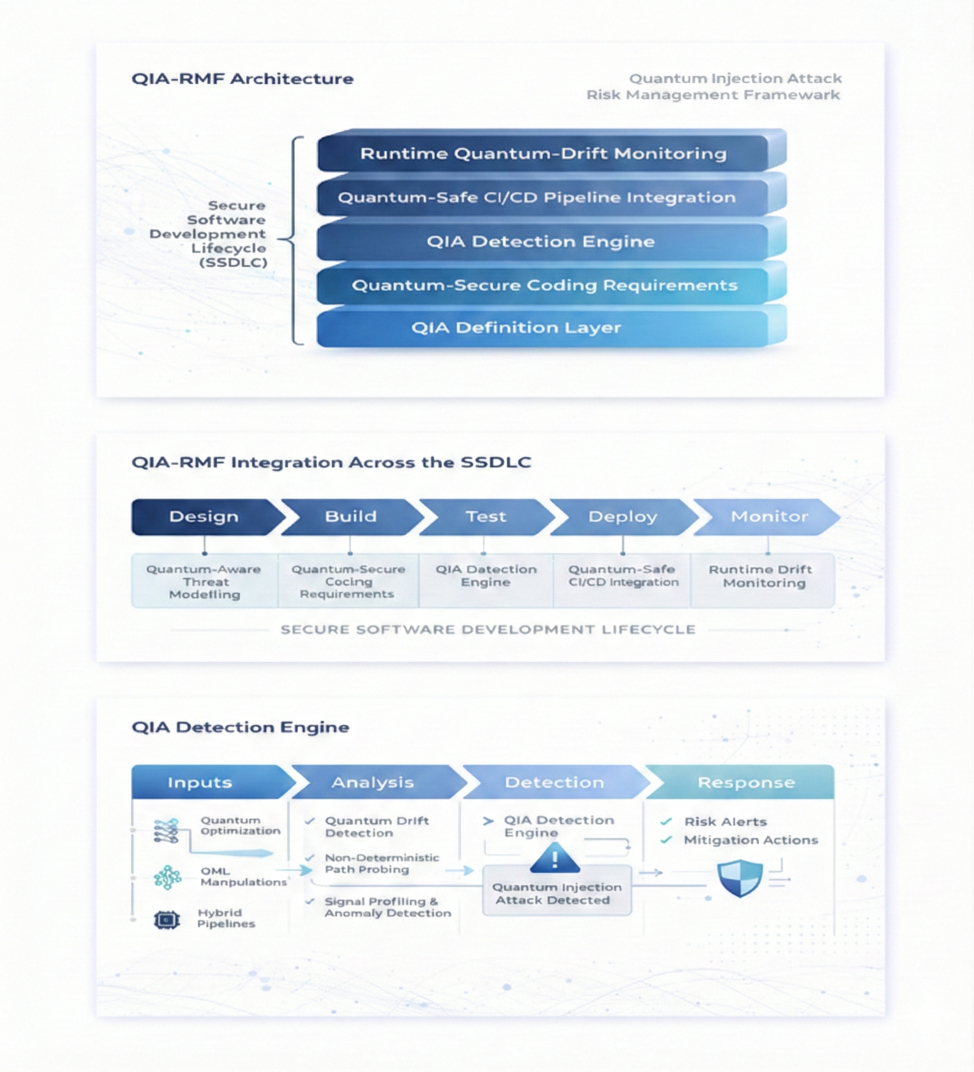
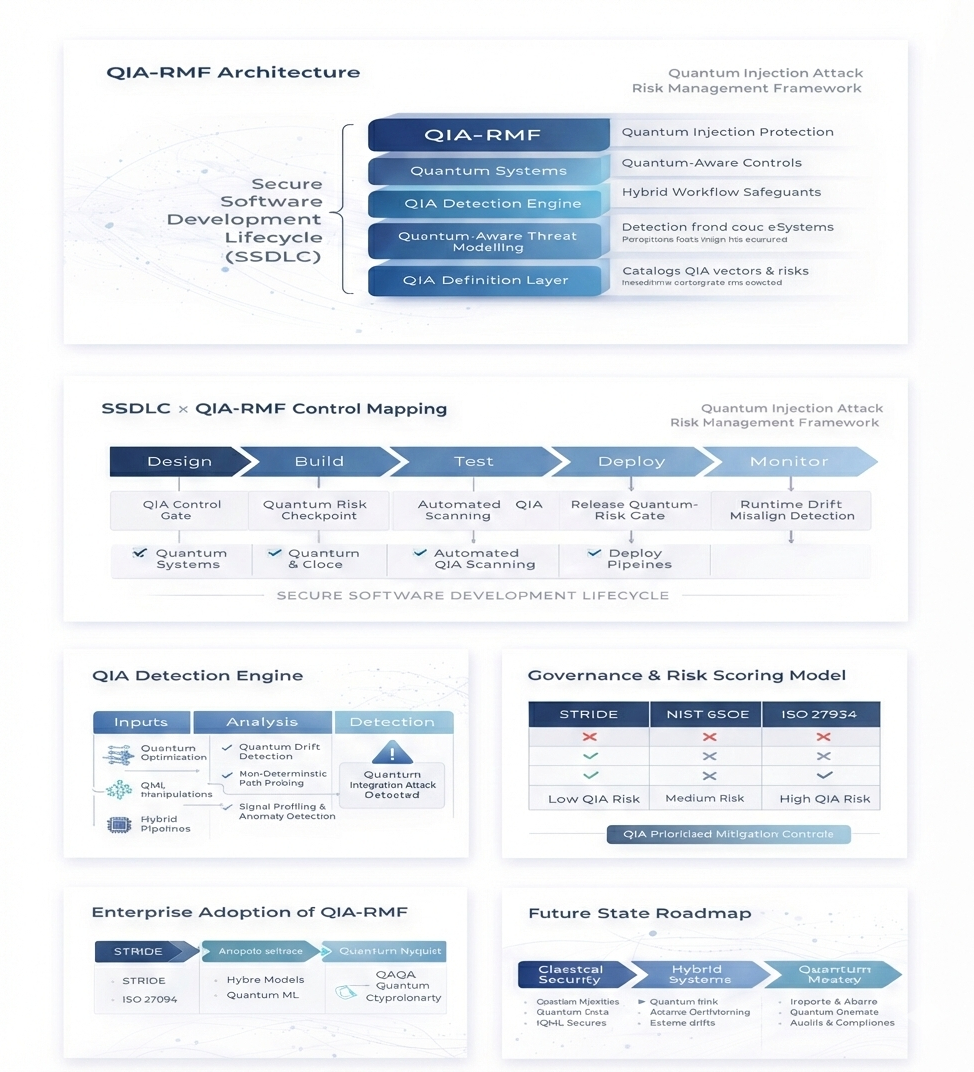
QIA-RMF is composed of layered components that work together to provide end-to-end quantum-aware risk management:
These layers integrate directly with existing development and security workflows.
QIA Definition Layer
Formal classification of Quantum Injection Attack vectors
Quantum-Aware Threat Modelling
Identification of probabilistic and hybrid risks
QIA Detection Engine
Analysis of behavioural drift and anomaly patterns
Quantum Systems Layer
Integration with quantum and hybrid execution environments
QIA-RMF Governance Layer
Risk scoring, controls, and enforcement mechanisms
Secure Software Development Lifecycle Integration
QIA-RMF embeds quantum-aware security controls across each phase of the Secure Software Development Lifecycle:
This approach ensures quantum-era risks are addressed early and continuously, rather than reactively.
Quantum risk identification and threat modelling
Quantum-aware adaptive control checkpoints
Automated QIA scanning and anomaly analysis
Quantum risk gates and release validation controls
Runtime drift detection and continuous risk assessment
Design
Build
Test
Deploy
Monitor
Secure Software Development Lifecycle Integration
QIA-RMF embeds quantum-aware security controls across each phase of the Secure Software Development Lifecycle:
This approach ensures quantum-era risks are addressed early and continuously, rather than reactively.
Design
Quantum risk identification and threat modelling
Build
Quantum-aware adaptive control checkpoints
Test
Automated QIA scanning and anomaly analysis
Deploy
Quantum risk gates and release validation controls
Monitor
Runtime drift detection and continuous risk assessment
Quantum Injection Attack Detection Engine
The QIA Detection Engine analyses system inputs and execution behaviour to identify indicators of quantum-induced risk, including:
Detected risks are classified, scored, and mapped to mitigation controls within the QIA-RMF governance model.
Non-deterministic execution drift
Optimisation bias anomalies
Hybrid system interference
Behavioural misalignment in AI and decision systems
Drift Detected
0%
Governance, Risk Scoring, and Controls
QIA-RMF introduces a structured governance model that assigns measurable risk scores to identified Quantum Injection Attacks. These scores inform:
This enables organisations to manage quantum-era risks with the same rigour applied to established cybersecurity domains.
Compliance and reporting decisions
Ongoing monitoring thresholds
Security gate enforcement
Control prioritisation
Incident response escalation
Quantum Injection Attack Detection Engine
The QIA-RMF framework has gained international recognition through independent media coverage highlighting its relevance to emerging quantum-era cybersecurity risks and governance challenges.
Independent Global Recognition
QIA-RMF has been acknowledged by international technology media, signalling external validation of its relevance and credibility.
TechBullion Feature Analysis
Coverage by TechBullion examined how the framework addresses quantum-era threats through a structured and forward-looking approach.
Early Quantum Risk Governance
The framework was highlighted for introducing early governance controls for Quantum Injection Attacks and hybrid system risks.
Growing Industry Attention
Media coverage reflects increasing interest in quantum-aware security models across technology and cybersecurity sectors.
Bisola Faith Kayode is a distinguished, UK-based cybersecurity and emerging-technology specialist who stands at the forefront of modern digital defense. With a robust portfolio of research and professional experience, she possesses deep expertise across the critical pillars of cybersecurity, artificial intelligence, and quantum-era risk management. Her work is dedicated to navigating the complex “convergence risk” where advanced computing systems intersect with traditional enterprise architectures.
Bisola specializes in identifying and mitigating nascent security gaps that arise from this technological evolution, prioritizing the development of practical, governance-driven frameworks. By bridging the gap between theoretical research and operational reality, she engineers resilient solutions designed to protect organizations against the next generation of cyber threats.